Zamzam Foundation supported 2.2 million people across Somalia in 2025, according to the organisation’s latest annual report. Our food distributions alone reached a record 1.7 million people as we expanded our emergency and seasonal programmes in response to the country’s worsening drought.
“There is much to be positive about in this annual report,” say Zamzam’s Chair and Executive Director in their joint foreword to the report. “It captures one of the most impactful years in Zamzam Foundation’s 33-year history.
“There is also much to concern us, with funding cuts biting at a time when humanitarian needs rose sharply in Somalia’s worst drought for 40 years.
“We owe a huge debt of gratitude to our dedicated staff and volunteers, and to the many partner organisations – local, national and international – who have stuck with us in challenging times.”
Somalia is among the ten poorest nations on earth, and the ten countries most vulnerable to climate change. Life expectancy is just 59, GDP per capita is barely $2 a day, and one in five Somalis have been driven from their homes by conflict, poverty, and the relentless impact of increasingly severe drought and floods.
It is against this challenging backdrop that Zamzam Foundation continues to work to save lives and assist the most vulnerable; to improve access to health, education and clean water; and to support livelihoods that empower people to lift themselves out of poverty.
Zamzam’s income fell by 4.7% in 2025 in a year of tight funding constraints, but the organisation was still able to report significant successes:
- We provided $14.5 million of lifesaving and lifechanging support to 2,198,689 Somalis across 16 of the country’s 18 regions
- Our network of 35 health facilities served 212,597 people – a record figure – as we opened four new health centres in hard-to-reach areas of Middle and Lower Juba and Gedo.
- Our livelihoods and climate resilience programme supported 38,894 people by empowering farmers, widows, young people and small family businesses to fight back against climate change – that is over 11,000 more beneficiaries than in 2024.
- We built five new schools – two in Mogadishu and the others in Middle and Lower Shabelle and Gedo. We educated 528 more children in Zamzam schools than the previous year, and our orphan sponsorship programme supported 2,745 more orphans – increases of 14% and 32% respectively.
- We delivered clean water and sanitation for 139,397 people, building or rehabilitating 107 new and existing boreholes and wells alongside the provision of new latrines and hygiene kits.
- A record 1,598,510 people received Ramadan food packs, Qurbani meat or Eid gifts.
- The peace committees we set up over several years, spearheaded by community leaders and elders, continue to prevent clan conflict in three regions: Galgaduud, Hiran and Middle Shabelle.
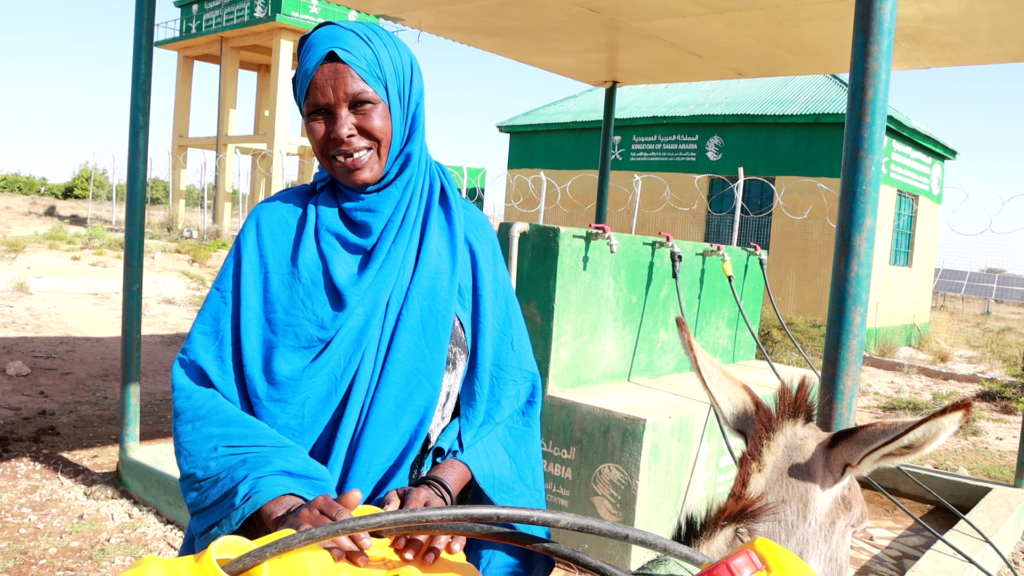
Our annual report features nine inspiring success stories featuring individuals who have benefited from Zamzam’s support through our various programmes – from schoolchildren to community elders. They include drought-affected mothers Amina Mohamed and Amina Ibrahim, both pictured on this page.
All Amina Mohamed’s livestock and crops were wiped out by drought. But the 30-year-old mother, who lives in a displacement camp in Baidoa, has a modest income from producing goat’s milk as one of 178 drought-affected farmers who received new goats or dairy cows from Zamzam in partnership with Qatar Charity.
“I sell some of the milk in the market and use the money to support my family,” she says. “I also give milk to my children to drink.”
Amina Ibrahim is one of 18,000 people benefiting from a new borehole we provided in a dry rural area near Hargeisa, with support from King Salman Humanitarian Aid and Relief Centre. Her children are less at risk from disease, and she no longer spends four hours a day looking for and collecting safe water.
“Previously our community depended on long journeys to the Arabsiyo area to get drinking water,” she explains.
Our annual report sets out the nine key pillars of Zamzam’s six-year strategic plan. It also includes two ‘partnership in action’ features that show the impact and effectiveness of some of the organisation’s key partnerships.
One of these articles covers integrated programmes supported by the European Union Humanitarian Office and the German Federal Ministry for International Cooperation and Development, reflecting the importance of a coordinated multi-sectoral approach when communities have complex and overlapping multi-sectoral needs. The other highlights how Zamzam is supporting 68,000 Zakat-eligible Somalis through Zakat donations from around the world – particularly from Türkiye, Kuwait, South Africa, Germany, Canada and Australia.
The report concludes with a section on Zamzam’s international outreach, campaigning and fundraising – including a summary of the valuable work of Zamzam Kenya, Zamzam Türkiye and Zamzam UK in extending the Zamzam family’s humanitarian impact, raising awareness and raising funds.