November 10th, 2025
Zamzam climate specialist calls for more support for climate-smart agriculture as world leaders gather for COP climate conference in Brazil
Somalis urgently need better climate finance, more support for climate-smart agriculture, and more investment in solar energy. That was the message of Zamzam Foundation climate change specialist Dr Hassan Ali Yusuf as world leaders gathered in Brazil for COP 30, the 30th annual United Nations climate conference (6-21 November).
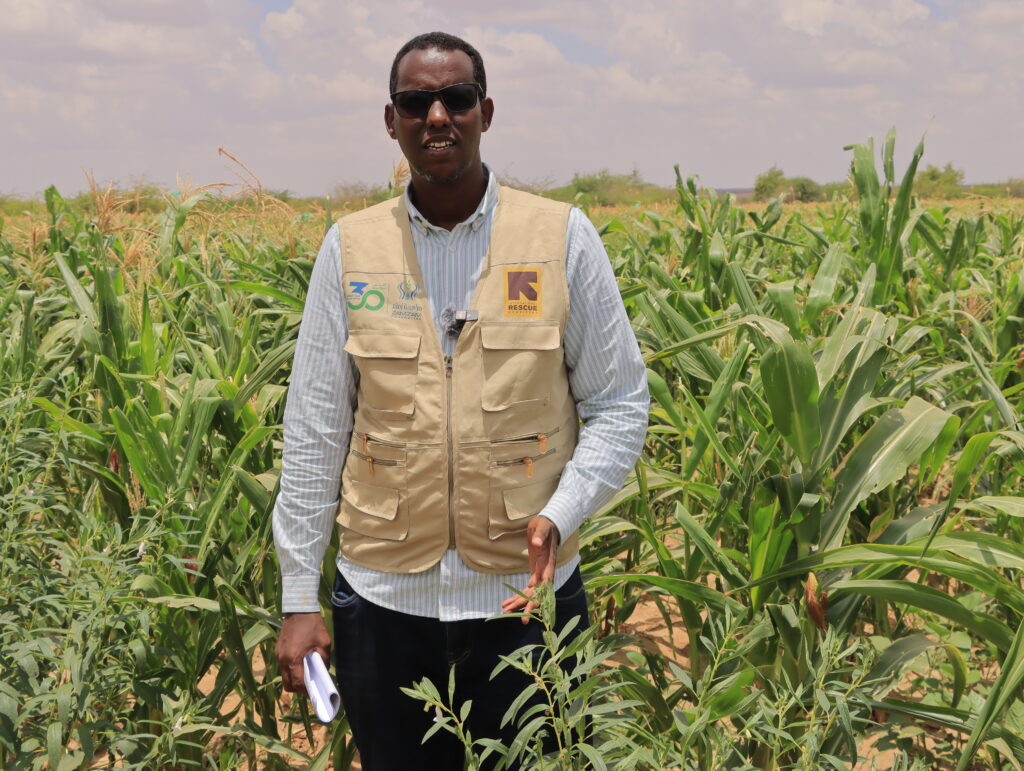
Dr Hassan is Project Manager of Zamzam’s OASIS project – Operationalising Agricultural Sustainability in Somalia. Strengthening the livelihoods of farmers is particularly crucial for building climate resilience, he emphasises, in a country where agriculture accounts for more than two-thirds of the economy.
“The farmers we are supporting are achieving so much,” Dr Hassan says. “Increased food security, higher incomes, better management of environmental resources, more consumption of local food, and growing awareness of nutrition. But much more international investment is needed in climate-smart agriculture programmes like OASIS if they are to succeed on a large scale.”
The priorities highlighted by Dr Hassan also featured prominently in a speech that Somalia’s Deputy Prime Minister made on the first day of COP (Conference of the Parties) in the Brazilian rainforest city of Belem. In a short address to the President of Brazil and COP delegates, Salah Ahmed Jama called for climate finance to be strengthened and welcomed the recent establishment of a ‘loss and damage’ fund to compensate countries like Somalia for the devastating impact climate change has already caused.
Mr Jama said: “I speak on behalf of my country, Somalia, a nation that contributes less than 0.019 per cent of greenhouse gas emissions and yet is ranked as one of the top three most hard hit countries in the frontline of the climate crisis.
“For Somalia climate change is not a distant future, it is here and happening. It is the mother who has to walk tens of kilometres to fetch water. Is the pastoralist who is losing his herds due to recurring drought. It is the child that ends up in a camp suffering from hunger and disease.
“Somalia comes to COP 30 with hope for action, armed with clear plans and strategies. The first priority is adaptation and resilience at a large scale. We seek partnerships that build early warning systems, climate-smart agriculture, resilient health systems, and climate-proof infrastructure. For Somalia adaptation is not charity, but justice.”
Zamzam’s Dr Hassan Ali Yusuf says most of the rangelands on which pastoralists depend now receive less than 400mm of rain in a year, and in parts of Somaliland extreme heat and drought have killed large numbers of livestock this year. In other areas, however, crops are being wiped out repeatedly by devastating floods, with heavy seasonal rains in the Ethiopian highlands causing Somali rivers downstream to burst their banks.
Zamzam is helping traditional livestock farmers to stay on their land by drilling solar-powered boreholes and digging wells, replacing animals lost to drought, supporting animal vaccination campaigns, and delivering training in hydroponic fodder production. Dr Hassan is pictured here showing how to grow fodder crops hydroponically – without soil and a minimum of water.
Zamzam is also supporting agro-pastoralism – an adaptation from pastoralism in which farmers grow crops under irrigation alongside retaining a smaller number of animals to prevent overgrazing. The animals still produce a smaller amount of milk and meat for family consumption and for sale, as well as providing manure to help nourish crops without overreliance on expensive and environmentally damaging chemical fertilisers. It is the crops that provide the main source of family income.
The OASIS project is a good example of what environmentally sensitive agropastoralism can achieve. It has supported 2,787 farmers in five villages in Beledweyne district to increase crop yields while better protecting the soil, water resources and pasture upon which their future livelihoods will depend.
This is successful climate-smart agriculture in action – something that Zamzam Foundation and the Deputy Prime Minister clearly agree is crucial for Somalia’s future as climate change bites.
“There is real hope for the future in the resilience of Somali farmers,” says Dr Hassan Ali Yusuf. “Let us hope that COP delivers meaningful support for a more climate-smart, resilient faming future.”
Want to support Somali farmers battling the effects of climate change? Please donate to our Brighter Futures livelihoods fund.